
I know the title might come across as "click-baity", so before we get into it, I want to give you some context to this article.
Everything I'm about to tell you is aimed at the professional musician who is already functionally good at what they do. It's for people who have been doing "the thing" for quite some time, who feel confident in their ability, and who are at the stage in their career where everybody around them is also good at what they do. The point of this article isn't to suggest you need to stop doing anything you're currently doing. It's to highlight an area of development for us as musicians that is systemically ignored, and that shining a light on it may help you to progress faster and with a better "hit rate" on the things you choose to put your time into.
Of course, if you're a student reading this, there will be some benefit to you too… You might find that you get better faster, that issues you've been facing suddenly drop away, and that you feel more in control of your instrument. But I don't want the overarching theme here to distract you from the facts.
Practice, regardless of everything you're about to read, is of paramount importance. And at no point here am I suggesting that you don't need to spend time with your instrument. You do. Without a doubt. It's a categorical fact.
In the same way professional golfers, footballers, astronauts, and now even elite level gamers spend time working on their craft, they also understand they need to train the body that delivers it.
So don't go thinking I'm giving you a "get out of jail free" card.
Turning Effortful into Effortless
Most musicians are told from an early age that they're "talented", or that they have an "innate gift". I'm not here to get bogged down in whether these elusive traits exist. I'm just here to point out that when you combine a belief in "magical ability" with practice, you will, of course, go a long way because of the positive reinforcement loop. But as the years go by, you’ll need to upgrade your mental models.
The overarching theme of this article is to help you transition from:
Talent + Practice = Success
To:
Physiology + Practice = Success
It's about making playing music, which is inherently very effortful, completely effortless. That's the goal. Luckily, the key to becoming effortless in your performance is remarkably straightforward. The better you feel, the easier high performance becomes.
Simple... On paper.
There are so many elements you need to think about for this to become a repeatable, consistent trait that you can access on demand. So first, let's shine a light on everything you need to master, so you can see exactly what you might be leaving on the table.
First, the obvious stuff.
This is what effortless sounds like. Time. Placement. Intonation. Dynamics. Touch. Sound. Accuracy. Phrasing. And everything else that is specific to playing your instrument. You can think of this as "the craft".
Next is how you use your body to create the sound.
Posture. Stability. Balance. Coordination. Sequencing. Grip. Mobility. Tension. It's essentially the mechanics that allow you to express your technique.
As musicians, we tend to address only the things that directly influence the sound. The tangible things from that first list. And if we're feeling clever, we might then take a look at the mechanics. But there's another layer you need to consider beneath it all.
That's the physiological layer. It's the substrate your mechanics are built from—the foundations without which everything else would crumble. If the first layer is what effortless sounds like, and the next layer is how you use your body to create the sound, then this layer is what your body has to use. It's the substrate.
In Performance Conditioning, this layer is split into three pillars.
Capacity: Strength, endurance, power, tendon resilience and energy systems.
Mindset: Nervous system state, mental CPU, breathing and body awareness.
Recovery: Sleep, load management, fatigue management and nutrition.
Effortlessness Isn't a Practice Problem. It's a Headroom Problem.
Notice how everything at the most foundational level has nothing directly to do with playing your instrument?
That's why, once you're functionally good, practice seems to give diminishing returns. Unless you're preparing for a specific gig, the things you need to work on most likely aren't related to the specifics of playing your instrument. You can do that already... Give yourself some credit!
In 2023, I had two brain injuries, and for a while it was up in the air whether I could carry on playing drums at all. Three years of rehab later, my whole relationship with the instrument had changed. Through the recovery process, I started dissecting "the art" of playing music because the foundational systems I had relied on for years were suddenly unreliable, and I needed to find a way to keep my playing at a high level so I could protect my job playing drums at Hamilton here in London.
If you know the gig, you'll know it's relentless, and there is a degree of microscopic precision involved that I've not come across anywhere else.
Through my dissection process, I started training both my body and mind in a completely new way. A way that wasn't taught to me through my years of education, and one that involved a huge amount of translation from research papers and specialists in other areas involving sport, neuroscience, and even the corporate world in its approach to the high performance mindset.
Through this exploration, I found that I started to get better at the drums, unravelling long-standing physical and mental issues along the way, to the point that I am a much stronger player now than I was prior to my brain injuries, without spending any more time in the practice room.
It was through this research, along with a combination of new qualifications, that I started working with professional musicians around the world to help them overcome their own physiological bottlenecks.
Those deeper layers are the enabler of effortlessness.
To understand how this works, you need to understand the concept of physiological headroom.
This idea originated from my neurologist. After my brain injuries, I could still do things, but I wouldn't know until afterwards that I'd “spilt the jug”. And the aim of my rehab was to calm my brain back down.
To get your head around it (no pun intended) I want you to picture a jug about three-quarters full of orange water (or another colour of your choice). The jug represents your physiology.
What we do as musicians comes with an inherent pressure, which creates a baseline amount of "load". In your jug, this load is represented by the water. When you add the late nights, travel, time zones, gig pressure, poor nutrition choices, the physicality of playing, plus everything else you come across in your day, the water level starts to rise. As it rises, the headroom between the water level and the lip of the jug starts to close. As the gap closes, your systems are put under strain, which reduces effortlessness, until it eventually overflows, which, for us as musicians, could be anything from burnout to injury and everything in between.
Some of that strain sits in systems you can't control directly, and some in systems you can. That difference becomes important later.
Right now, it's important to note that people in other industries take this stuff extremely seriously.
In the world of sport, they call this "load management". The International Olympic Committee's 2016 consensus statement defines load as "the sport and non-sport burden" on an athlete: any physiological, psychological or mechanical stressor, applied as a stimulus to anything from a single cell to the whole person.
Translated into "muggle speak", that just means "anything that affects how well your body is balanced, in life or in playing".
And it's that balance that takes you from effortful to effortless in a way that is entirely repeatable and accessible from wherever you’re starting your day.
Balance, in theory, should be pretty simple.
Just relax.
But the reality is that these systems are fragile, and vague advice like “just relax” seldom helps in practice.
The Headroom Method
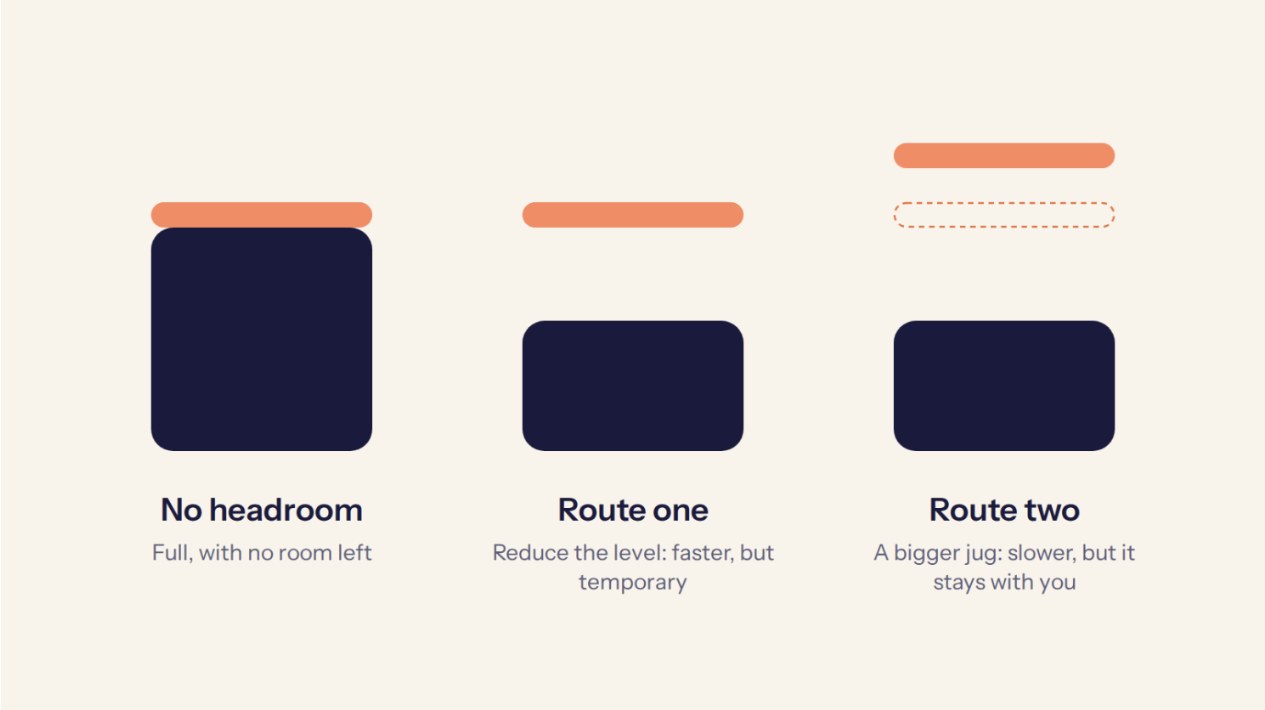
The Headroom Method is the system I use with the people I work with.
Let's start with the first jug. If you do nothing, this is where most people end up. For some, that becomes obvious (sometimes painfully). For others, it's a weird, invisible block they can't seem to get past in their practice.
The tricky part is that most people don't realise their jug is full. So they put two and two together and get five, because the overflow shows up in their playing as an instrument related problem... Your time drifts. Your placement gets edgy, or your intonation slips. You start making unexplained “fumbles”. You stop hearing the whole band and start hearing only yourself. You start second-guessing, wondering what everyone else is thinking. So you go back to the practice room to fix it.
You may be thinking, “But Chris! How am I meant to know if this is a practice problem or a physiological one?”
Well, although this isn’t the case 100% of the time, the following rule is a pretty good yardstick: If you can play it reliably in the practice room, and it only falls apart on the gig, it likely isn't a technical problem. It's a physiological one.
The Two Routes
Once you’ve identified a physiological issue, there are two routes you can take to create headroom:
- Reduce the water in the jug
- Increase the size of the jug
As you’ll find out shortly, it’s not really a case of either/or. It’s a case of needing both, as they answer separate, rather more nuanced problems.
But before you can take either route, you need to know where you're starting from. And I guarantee that starting point will vary from one day to the next.
After all, Google Maps is useless for getting you from A to B if you don't know where A is. So you need to "find signal" and get your system back online.
This skill is called interoception.
It's the meta-skill of sensing your internal senses.
Before you label me woo-woo or a hippy, hear me out.
If you have kids, you'll be watching this skill develop day in, day out. Take hunger. Your kids need to learn to sense hunger cues in all the forms they come in. How hungry are they? Hungry for what? When did they last eat? When are they next meant to eat? What meal of the day is it? Should it just be a snack? Or is it dinner, and they need to eat enough to get through to the next day, even if they don't feel that hungry at the time? Then there's potty training. We're going through this at the moment with our youngest. They need to know the sensations, how strong each sensation is, and what to say, and in what order, to match what they're feeling. It's remarkably complicated. And it all comes down to the skill of interoception.
The same is true of adults. It's just that we become less in tune with ourselves as we get older.
That's not to say we're all going around having unfortunate accidents. Just that life becomes more nuanced, and sensing your internal senses takes on a depth that many of us fall out of tune with.
So interoception is a real sense, and a hugely important skill.
How does that apply here?
Well, it all starts with "How are you feeling today?"
That's your home base. It's you "finding signal". And once you have that signal, it's a damn sight easier to work out how to get where you need to go.
So let me walk you through the two routes you can take once you've found your starting point.
Route One: Decrease the Level
The first route is to decrease the level of the water in the metaphorical jug to regain your headroom.
This work is faster to achieve, but it's also relatively temporary. This route is about influencing your autonomic nervous system—things like your heart rate, digestion, blood pressure and body temperature. It's the system that looks after your unconscious functions, and you have no direct control over it.
Very simply, this system has two main parts:
- The sympathetic system: Your physiological accelerator. It's often known as your stress response, but I prefer to call it the mobilisation response. "Stress" frames it negatively, and ultimately you need it for performing, so you don't want a negative relationship with it.
- The parasympathetic system: Your physiological brake. It's often known as your "rest and digest" system, a name that can make you think it's passive and to do with food. In reality, it's the function that helps your body restore and repair.
You need both of these systems to work in harmony, and the goal is to keep them balanced.
The problem for a performer arises when you're under pressure and your mobilisation response becomes dominant. But equally, if you're shattered from travel and you've been spun on your head by time zones and jet lag, sometimes mobilisation is exactly what you need.
It just depends on the situation.
As you can't influence these systems directly, you need to use tools.
And for that, there are three main pathways you can take:
Top-down (brain → body): Meditation. NSDR. Reframing. Journaling. Visualisation. Gratitude practice.
Bottom-up (body → brain): Breathwork. Walking. Rope flow. Soft-tissue work. Hanging. Vestibular work. Resistance training.
Outside-in (world → body): Cold. Heat. Morning daylight. Less light at night. Functional music. Aromatherapy. Vagal toning devices.
That's a lot of tools!
So the next question is how you know which one to use, and when.
For that, I use a framework called State → System → Tool.
It works like this.
First, identify the situation. For example, you've been teaching all day and you've got a gig tonight. Second, work out your state. Here, you might find you're mentally tired, which sits in your nervous system. From there, you can match a tool to the system. You might choose ten minutes of NSDR (non-sleep deep rest, a term coined by neuroscientist Andrew Huberman for practices such as yoga nidra).
Another nervous system capacity issue might come from a long day of rehearsals before playing a gig in the evening. Sometimes, high playing loads can lead to neural fatigue, which feels like a slight slowness and lack of connection between your brain and body, as if it’s not quite firing fast enough. Here, you might choose to make slightly different musical decisions to ensure you stay within your capacity.
To give you another example, say you're aching after a show. You're physically tired, which sits in your musculoskeletal system, so you might reach for rope flow, or a deadhang and stretch out. Or you played a late gig and you've got an early start. You're poorly slept, which sits in your nervous system, so cold exposure might be the tool to use.
There are many ways you can apply this framework… far too many to list in this article.
But you get the idea.
For more like this, check out my book, The Inner Athlete: A Musician's Guide To Performance Conditioning.
Route Two: Increase the Size of the Jug
Let's go back to the jug.
If route one is the faster but more temporary work that lowers the water level until "life" puts it back, route two is the slower but permanent work that increases the size of the jug. This route allows you not only to maintain your headroom when things get pressured, but also cope with more.
And for this, you need to understand another part of your nervous system.
This time, the somatic system.
This is the part of the nervous system that connects your brain to your muscles. If you imagine your brain as a fuse board and your muscles as your appliances, then the somatic nervous system is the wiring connecting them all together.
When you practise, you're directly developing this system. Practice and repetition automate parts of your playing, which is how you get that feeling of effortlessness in the practice room. But the issue is that it's inherently a manual system, and the pressure of performing can easily booby-trap it. If this system doesn't have enough headroom built into it, then the red light, sight-reading charts, a dodgy bass player, poor monitoring, or whatever else life has thrown at you can cause those automations to fail. That leaves you up the creek without a paddle, so to speak.
The other thing you need to consider is that, as you age, your physiology naturally reduces your headroom.
Loss of muscle mass, decreased bone density, and loss of balance and quickness. All the while, as you become more established as a player, your diary starts to demand more of you than ever before. These two opposing forces create a cavern that's fraught with risk of injury and a general loss of optimisation. In short, you need to be able to play at your best, but your physiology has a shrinking reserve of the building blocks required for repeatable high performance.
There is only one fix for all of this.
And that fix is to train your body.
A stronger muscle needs a smaller signal from your brain to produce the same force. And smaller signals are cleaner signals.
When a muscle is weak, your brain has to shout, and a shout carries more noise. That noise is the wobble in a quiet note, the placement that drifts when you're tired, the control that goes when the pressure comes on. Train the muscle, and your brain can whisper instead. And when the signal is clean, the body can relax and stabilise itself efficiently, which in turn allows the energy to travel, unhindered, from A to B so you can express your technique in the way you hear it in your mind.
That's what the Capacity pillar is for that we spoke about in the beginning. Strength, endurance, power, tendon resilience and energy systems, built progressively in the gym, so that playing costs you less of what you've got, and you can express your technique with effortlessness.
We, as an industry, need to move away from the narrative that talent and practice are the be-all and end-all. Ultimately, your mechanics are the foundation of your technique. And your physiology is the foundation of your mechanics. And that means you need to train your physiology with the same progressive approach that you take to the practice room.
As a musician, your availability to perform comes above all else.
If you've lost your protective buffer and ended up injured or in pain (a 2016 review of 21 studies found that between 62% and 93% of professional musicians experience musculoskeletal complaints at some point in their career), or you've simply ended up in a place where you feel less connected to your instrument, there are so many reasons to move your mental model of performing away from the traditional wisdom of talent + practice, and start adopting the mindset of physiology + practice.
So, tangibly, what are the benefits of applying the headroom method to your arsenal?
From route one, you’ll see:
- Better musical decisions
- More “mental CPU”
- And more of those performances where you feel like you're watching yourself play from the outside as a spectator of your own performance, which means you can listen to yourself objectively.
From route two, you’ll get
- A protective buffer
- More endurance and power
- And you’ll find the demands of the gig taking a smaller share of a bigger physical reserve.
And if you adopt both, you’ll acquire everything above, plus precision and command over your instrument, access to your full ability rather than a stress-limited version of it, and a more consistent standard of performance, even on your "worse" days.
So, to tie it all together...
Remember those pillars from the top of this article?
Recovery is your route one work. It's how you reduce the water level in your existing jug. And it involves protocols you can use both on stage and off stage. Capacity is your route two work. It's gym-based (although you can do it from anywhere), and although it might look like generic fitness, the demands we place on ourselves physically as musicians call for a very specific approach to training (which is exactly how I train people within the Performance Conditioning Training Club). And the mindset work? Well, that straddles both route one and route two.
What Next?
If you've read this far, you might be wondering what you can do next to put all this into action.
That's exactly why I created the Performance Conditioning Quiz.
It takes less than three minutes to complete, and it benchmarks you against the three pillars of Performance Conditioning: Capacity, Mindset and Recovery. From there, you'll get personalised results, so you know exactly what to do next.
If you want to check it out, head to performanceconditioning.co/quiz
That's it!