
How the Artist Preparation Pyramid sets the standard for touring artists.
In sport, nobody would dream of sending an athlete into a season without preparing them for it first.
There's a pre-season. There are strength and conditioning coaches, sports scientists, physios, and a full performance team who pull all the information together to make informed decisions. There's a plan for the travel, the fixtures, the recovery, and for keeping the athlete not just healthy, but on top form.
The world of sport understands that only one thing matters, and it protects it ruthlessly: The availability of the athletes to perform at their best for the duration of the season.
Without that focus, they simply wouldn't stand a chance.
The fans would be disappointed. The club's hard-earned reputation would be slashed. It would lose money. Contracts and sponsorships would be put at risk. That, in sport, is the game within the game, and without actively playing it, management will categorically fail in their mission to make it to the top.
In the music industry, things are different.
To see why, you have to look at how the industry has changed since Napster arrived in 1999. The days of making money from records are gone. Streaming, for all the good it has done for global reach, has decimated album sales. And in an increasingly digital world, with flexible, post-COVID working now the norm for most white-collar workers, there's more demand than ever for real-life experiences. That trend will only continue, and the more it does, the more reliant we, as an industry, will become on touring, both as a revenue driver and as a response to the consumer's growing demand for human connection. That means touring schedules become more brutal as artists stretch to meet the demand of loyal fans.
As a result, having a good product goes without saying, and becoming durable as a touring party becomes the non-negotiable goal, not just for the next tour, but for the entire length of that artist's career.
That means physical preparation is no longer a "nice-to-have".
It should be a fundamental part of the artist's life, both as preparation to smooth the on-ramp from "off-season" to "on-season", and as day-to-day maintenance mid-campaign.
The issue is that the culture is stuck in the analogue, pre-streaming mindset that touring supports records, as if it's just a small piece of the bigger picture. These days, it's the other way round. Economically, albums serve as a vehicle to acquire fans, and as a loss leader to sell tickets to the main event: the tour. (It's still art, of course. But the maths has flipped.) And that changes what's asked of artists and musicians. Records are recorded once and played over and over. Touring requires repeatability. And repeatability requires careful consideration and proper preparation to create the physiological "headroom" needed to cope with the demands of the road.
At best, those who have clocked this tend to work with generic trainers who don't understand the physical toll of performing and the nuances of playing an instrument. It's the equivalent of Michael Phelps going into the Olympics without the four years of targeted training, or training only with a body composition specialist.
At the end of the day, these athletes have specific needs.
So do musicians.
And these needs, if not met, can stunt an artist's growth and damage the pockets of the stakeholders if they acquire an injury, which some studies suggest is up to 93% likely.
Those figures, if discovered in sport, would trigger a government inquiry.
But in the world of music, they're shrugged off as "bad luck", or "it couldn't be avoided".
I beg to differ.
Why Tour Preparation Is Different for Musicians
A Premier League footballer plays fifty to sixty matches a year, with an entire training and recovery package built around them.
A touring musician might play a hundred and fifty shows in six months, with brutal travel, broken sleep, and no training or recovery protocol to speak of. And that's before you factor in what touring does to you. Flights. Time zones. Long drives through the night. A different hotel bed every other night. Late finishes, early lobby calls, back-to-back shows, press obligations, and more.
We tend to think about the health of artists and their musicians in a binary way. You're fine, or you're injured. You can play, or you can't. But the body doesn't work like that. It's a spectrum, in the same way that your car stereo doesn't just have an on and an off button. It has a volume control.
Ultimately, what's needed is a cultural shift where we think proactively rather than reactively. That means viewing physical preparation as optimisation: working not just on strength, mobility and conditioning, but on the sequencing and timing of healthy movement, so the artist or musician can learn to stabilise each joint the way it was biomechanically designed to work. Doing this gives them the opportunity to balance healthy tension across the body, so each muscle, tendon and joint can do what it's naturally supposed to do.
This is how you get out of the way of your technique, and ultimately express it more efficiently.
It's as much about supporting the craft of being a musician as it is about building durability and resilience.
At the end of the day, you can sub out a band member (provided you have the notice), but you can't sub the main artist. When they go down, the show goes down with them, and the cascade of consequences starts from there.
The press releases, the disappointed fans, the admin nightmare. Not to mention the revenue. And then there are the lost wages for the people whose livelihoods depend on the shows going ahead. Crew. Lighting. Sound. Tech. Riggers. Wardrobe. Drivers. Catering. Security. The support acts and their crew. Venue staff. Merch sellers. Food traders. Local hotels and hospitality. It goes on and on…
When it comes to preparation, no two instruments are the same. And the thing that breaks an artist or band member usually isn't a single, one-off, acute event, but a gradual accumulation of stressors on the body over time.
The job of physical preparation is to build these systems up over time, increasing capacity by creating movement efficiencies and enough "physiological headroom" that the performer can work well within their comfort zone (because they're expending a smaller percentage of something bigger during performance), whilst creating a protective buffer around them that reduces the risk of injury.
This is why generic fitness advice doesn't work for musicians.
Preparation has to be built around the person, their instrument, their schedule, and the cascade of nuances that come with the territory.
The Artist Preparation Pyramid
The Artist Preparation Pyramid is a framework for musicians, artists and their management that sets both the standard and the priorities for tour preparation and maintenance.
It ensures the artist is physically prepared for both the durability demands of their schedule and the enhancement of their technical expression and stage presence, without increasing the risk of injury or compromising their ability to perform. The framework combines performance goals, "life" goals and aesthetic goals.
The pyramid works from the bottom up. The base and the middle are the protection and the substrate. The top is what the artist, and the audience, actually experience.
You can't get the top without the base.
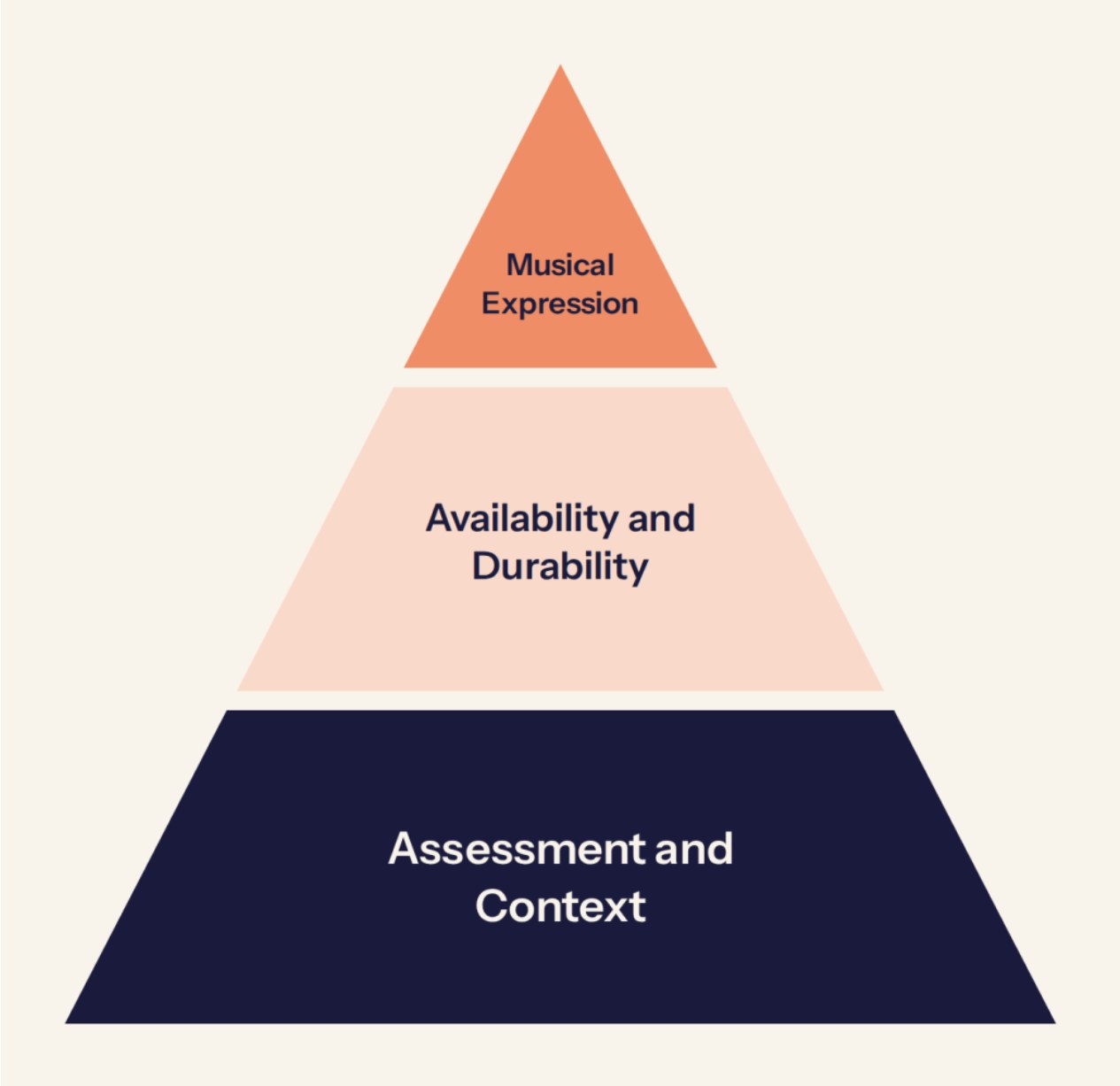
Layer 1: Assessment and Context
The foundation of preparation lies in understanding the artist or musician, what they play, and what the upcoming schedule is demanding of them.
Before we get into the training, we establish the baseline and what the artist's starting point looks like. Then we reverse-engineer a plan that looks at the schedule, how they move on stage, and their unique experiences. This means assessing movement quality and mechanics, lifestyle, injury history and training history, to build a plan that meets them where they are. By looking at the specific way an artist moves on stage and their performance style, we can make sure the training is relevant to the way they actually perform and the outcomes they need.
Working this way removes unnecessary load and work from the process, and keeps training specific, measurable and aligned to the task at hand, preventing it from drifting towards a generic approach.
Layer 2: Availability and Durability
As discussed above, availability is the number one goal. And durability is the quality we need to build to make sure availability is met.
Think of it as a form of performance insurance.
To protect availability, you need to consider the artist's global load management, factoring performances, rehearsals, training and all of the other stressors on the body into the equation. At the end of the day, the body doesn't distinguish when it comes to "load". Everything pulls from the same reserves. Specific to training, this means looking at movement quality and joint ranges, recovery capacity and protocols, fuelling, and more subjective measures of load, and how they all come together to balance training and performance sustainably and in tandem. These factors ultimately influence how durable an artist can become, and help us understand where the weak spots are, so they're met with a well-rounded training stimulus.
By working through different types of load, directions, combinations of movements, speeds and volumes, we can emulate and exceed the demands of the performance schedule in training, with an approach that builds capacity, and therefore durability and availability, in a controlled, safe way.
Layer 3: Musical Expression
Traditionally, this is where most artists and musicians start.
But by now you can see the previously invisible base that musical expression sits on. Once the mechanical capacity and durability are in place to tolerate the demands of performing, we can refine the instrument and style-specific elements. This is also where the aesthetic layer is factored in. Most people start with aesthetics, but here they come as a by-product of the training, provided an adequate nutritional strategy is in place.
This layer is the connective tissue between the substrate-building work of the previous layers and the performance-specific qualities, including:
- Control and command of the instrument.
- Freedom to move without excess tension or restriction.
- Show-specific capacity: whatever the show specifically demands.
- Freedom on stage to perform the show the way it's been envisioned.
- Repeatability to do it all again tomorrow night, and every night after that.
The magic of training is that it makes what is inherently very effortful look completely effortless to the audience.
That's the goal: to turn the effortful into the effortless.
What Tour Preparation Looks Like in Practice
In practice, it runs in three stages:
- Before prep begins (ideally 16-20 weeks out): The artist or musician is assessed, the on-ramp to the tour is mapped out, and a training plan is reverse-engineered from it.
- During prep (ideally 12-16 weeks out): Training builds from the base up, following the periodised plan created in the first stage. It factors in rehearsals and other commitments, so load is properly managed and training works in tandem with day-to-day life.
- On the road: This is where most preparation falls apart. The tour starts, and the routine disappears. With this structure of support, however, the focus becomes supporting the schedule, undoing the physiological effects of performance, and continuing to train on tour using a variety of techniques and methods. Global load, capacity and recovery are reviewed through a combination of objective and subjective measures, so we have eyes on the full picture at all times. That lets us make intelligent decisions about how to support the schedule day to day.
Preparing for a Tour?
If you're an artist, a manager or a tour manager with a tour on the horizon, let's talk about what preparation to this standard would look like for you.
Start a conversation and let's have an informal chat.
Frequently Asked Questions
What is the Artist Preparation Pyramid?
It's a framework for musicians, artists and their management that sets both the standard and the priorities for tour preparation and maintenance. It has three layers, built from the bottom up: Assessment and Context, Availability and Durability, and Musical Expression.
How common are injuries in professional musicians?
Very. A systematic review of the research puts the lifetime prevalence of musculoskeletal complaints in professional musicians at between 62% and 93%. A more recent overview of eighteen systematic reviews found rates between 39% and 93%, with higher rates among musicians with intense schedules.
Why doesn't generic fitness training work for musicians?
Because it isn't built around the demands of performing. Generic trainers rarely understand the physical toll of playing an instrument, or that training, rehearsals, shows and travel all pull from the same reserves. Preparation has to be built around the person and their schedule, taking their performance style and the asymmetries of their particular instrument into account, to name just a couple of factors.
What happens if an artist picks up an injury on tour?
It's surprisingly common, which is why the support doesn't stop when the tour starts. Artists have weekly reviews with me throughout the run, plus direct access to me for anything that comes up in between. If an issue does come up, niggleIQ, my triage tool, traffic-lights it, so we can make more intelligent and timely decisions about whether to adapt the training, keep an eye on it, or refer it on to the right specialist. The aim is to catch things early. Because you can sub out a band member (provided you have the notice), but you can't sub the main artist. When they go down, the show goes down with them.
Does physical preparation stop once the tour starts?
No. Most preparation falls apart once touring starts, which is why my approach to training is specifically designed to work in the gym, at home when time is tight, and on tour, with a travel version of every exercise, so you don't have to rely on dodgy hotel gyms. All you need is a very small setup to keep the wheels on the track, so to speak.
Will physical preparation change how an artist looks?
It can, but within the pyramid, aesthetic changes come as a by-product of the training, provided an adequate nutritional strategy is in place. They're never the starting point. That said, most people have a personal aesthetic goal, and training takes it into account so you can see the benefits too.